রবিবার, ২২ নভেম্বর ২০২৬, ০৬:৩৯ পূর্বাহ্ন


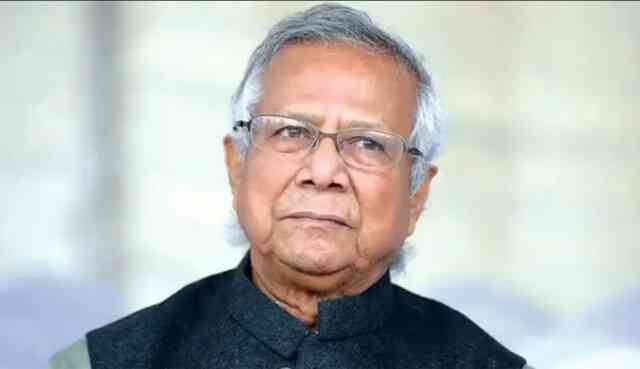
DOHA (Qatar), April 22, 2025 (BSS) – Chief Adviser Professor Muhammad Yunus today urged the global leaders not to forget Palestine and Rohingyas crises, saying the Palestinians are not expendable.
“The world must not ignore the humanitarian crises that affect people from Palestine to the Rohingyas in Bangladesh,” he said while delivering his keynote speech at Earthna Summit in Doha, Qatar.
The chief adviser said impunity and blatant disregard for human rights are threats to development anywhere in the world.
“The ongoing suffering in Palestine concerns not just a region, but all of humanity. Palestinians are not expendable,” he added.
Prof Yunus, also the 2006 Noble Peace Laureate, said the protracted crisis in Myanmar continues to threaten regional stability.
For years, he said Bangladesh has hosted over 1.2 million Rohingya refugees, bearing significant social, economic, and environmental costs.
The UN Secretary-General recently visited the camps in a gesture of solidarity, he said, adding that while global efforts continue, world leaders must come together to ensure the safe, sustainable and dignified repatriation of the Rohingya people to their homes in Myanmar.
The chief adviser said although the world dreams for a resilient, prosperous, and sustainable future for all, there are various threats that can derail the future development.
“We live in a time of profound uncertainty, where multilateralism is under serious threat, climate change is accelerating, geopolitical tensions are rising, and humanitarian crises are deepening,” he noted.
“Emerging norms, technologies, and governance models are rapidly reshaping our world, rendering many past assumptions obsolete. The urgency for renewed regional and global cooperation has never been greater,” he said.
The 2006 Nobel Peace Laureate said in today’s crisis prone world, wars and conflicts erode rights and disrupt economies.
Peace and stability are fundamental prerequisites for any meaningful and sustainable development, he said.
He highlighted that the climate crisis is also intensifying and the fact that funding for the global effort in this regard may dwindle in future.
Observing that climate change is an existential threat for all, Prof Yunus said: “However, we are still continuing to uphold self-destructive values. We have chosen a lifestyle that works against nature; one that thrives on limitless consumption.”
He said profit maximisation is treated like the force of gravity, propelling every element of the system toward unsustainable outcomes.
The safety of environment demands a new way of living which is based on the principles of zero net carbon emissions, zero wealth concentration through the creation of social businesses, and zero unemployment by becoming entrepreneurs,” the chief adviser said.
“This is how we will create a new civilisation that fosters sustainable development for everyone, everywhere,” he added.
Chief Adviser Professor Muhammad Yunus today placed six proposals at Earthna Summit here, saying the path to a sustainable and equitable future lies in collective action.
While delivering his keynote speech at the summit, he said first, the world must expand financial inclusion to reach all marginalised communities empowering individuals with the financial tools they need to build livelihoods and participate fully in the economy.
“Second, we must champion social business as a powerful tool for addressing social and environmental challenges, fostering enterprises that prioritise purpose over profit,” the chief adviser said.
Thirdly, he said the world must recognise the crucial role of youth as agents of change, creating platforms for their voices to be heard and investing in their skills and potential.
“Fourthly, we must work towards peace and justice globally, recognising that these are fundamental prerequisites for sustainable development and the well-being of all humanity,” he said.
In his fifth proposal, Prof Yunus said the moral obligation of the global community should not be forgotten for providing necessary financing for undertaking the aforementioned activities.
He said developed countries must meet their ODA commitments, particularly the 0.2% GNI target for the LDCs, which remains at 0.09%.
Enhanced concessional financing, with disaster clauses, is critical for sustaining development momentum including in the graduating countries,” the chief adviser said.
“Finally, we must create another culture; a counter-culture based on a different lifestyle. This lifestyle will be rooted in zero waste, zero carbon, and an economy based primarily on zero personal profit, i.e., on social business,” he said.
Prof Yunus said this kind of business is a non-dividend enterprise designed specifically to solve social and environmental problems.
About the global challenges, he said: “The challenges before us are significant. But so too is our capacity for innovation, compassion, and collective action.”
The chief adviser said Qatar with its initiatives like the Earthna Summit is demonstrating how a nation can harness innovation, tradition, and partnership to address the climate crisis, social inequality, and the future of work.
“My country, Bangladesh, now stands at a turning point to forge a new social contract in which the state and its people, especially its youth, co-create a future rooted in inclusion, tradition, justice, dignity, and opportunity,” he said.
Prof Yunus mentioned a social contract in which financial inclusion and the empowerment of marginalised communities become integral.
Noting that Bangladesh wants to stand as a beacon of hope for the world, he invited its friends and partners to rewrite inclusive social contracts and to explore the role of social business, financial inclusion, and microfinance in fostering sustainable development and economic opportunities for the marginalised.
“Let us be bold. Let us build a world where no one is too poor to dream and no dream is too big to achieve. I leave you with this: the future is not something we inherit. It is something we create. And each one of us has a role to play,” Prof Yunus concluded.
Claiming that social business can bring millions of people out of poverty, Chief Adviser Professor Muhammad Yunus today said poverty is created due to a wrong economic system.
“We are aware that poverty is not created by poor people. It is a consequence of an economic system where resources surge upwards, concentrating wealth ever more narrowly,” he said.
Prof Yunus made the remarks while delivering his keynote speech on ‘Exploring the role of social business, financial inclusion, and microfinance in fostering sustainable development and economic opportunities for marginalised communities’ at Earthna Summit, organised by Qatar Foundation, in Doha, Qatar.
He said social business armed with the power of financial inclusion can break free of this trap and can move millions out of poverty.
“Today, I will share the firsthand experiences of the power of two interrelated innovative approaches of social business and microcredit that have uplifted marginalised communities in my own country,” he said.
In Bangladesh, the chief adviser said microcredit model showed that even the poorest individuals are creditworthy.
By offering small, collateral-free loans, microcredit empowers individuals to build livelihoods, generate income, and lift themselves and their families out of poverty, he said.
The Grameen Bank founder said microcredit has a strong track record of success, most notably through the pioneering work of Grameen Bank in Bangladesh.
Founded on trust, he said the bank provided collateral-free microloans to poor villagers, especially women.
It has empowered over 300 million people globally by unlocking their entrepreneurial potential, he mentioned.
Prof Yunus said Grameen Bank itself lends over US$ 2.5 billion annually to 9 million women with a remarkable repayment rate of nearly 99%.
He said this model has been successfully replicated in various countries, including the United States through Grameen America, while over US$ 600 million in loans was provided to over 86,000 low-income women with a repayment rate exceeding 99%.
The chief adviser said stories of entrepreneurs like Damaris in Boston expanding her restaurant and Reyna in Texas growing her boutique exemplify the transformative impact of microcredit.
Furthermore, he said platforms like Kiva have facilitated over US$ 960 million in loans by connecting individual lenders with entrepreneurs in 82 countries.
Another transformative force in the pursuit of a more inclusive and sustainable world is social business, he said, adding that arising from the experiences of Grameen Bank, numerous social businesses have addressed critical issues.
Prof Yunus said Grameen Danone Foods provides fortified yogurt to malnourished children in Bangladesh, while Grameen Euglena produces nutritious cookies and supports local farmers.
Social business has fostered ventures like Golden Bees in Uganda, connecting small farmers to markets, and Impact Water, providing safe drinking water in Ugandan schools, he mentioned.
Globally, the chief adviser said Human Harbor Corporation in Japan tackles waste recycling and employs ex-prisoners, and joint ventures like Campo Vivo in Colombia and Bon et Bien in France address poverty and food waste in collaboration with major corporations.
He said the increasing number of social business funds and the growing interest from corporations and young entrepreneurs worldwide signify the expanding impact and potential of this model to create sustainable solutions for societal challenges.
“I am hopeful that these combined initiatives will help us to achieve the target of three zeroes- zero poverty, zero unemployment, and zero net carbon emissions. This is not a utopia. It is a vision rooted in what I have witnessed firsthand. And I sincerely hope they will lead to the path of fourth zero – zero waste.”
He said zero waste is a philosophy and a practical approach aimed at eliminating waste – not just managing it.
Prof Yunus said the goal is to design and use products and processes that minimise the generation of waste and ensure that all materials are reused, recycled, or composted rather than sent to landfills or incinerators.
He said this approach not only protects the environment by reducing pollution and conserving natural resources but also promotes sustainable production, ethical consumption, and economic efficiency.
By adopting this policy, individuals, businesses, and governments can significantly lower their environmental footprint and move toward a cleaner, greener, and more sustainable future, he said.
“However, in this endeavor, we must not forget the importance of traditional learning and cultures. It has often been noted that on many occasions traditional solution provides the best cure for many modern problems,” the chief adviser said.
“Hence, all our endeavors for ensuring a sustainable future for everyone need to build on the traditional knowledge and culture to ensure its sustenance,” he added.
Sheikha Moza bint Nasser, Chairperson of Qatar Foundation, and Sheikha Hind bint Hamad Al Thani, Vice Chairperson and CEO of the Qatar Foundation, were present at the summit, among other, global leaders.