বুধবার, ১৭ জুন ২০২৬, ০৬:৩৭ অপরাহ্ন



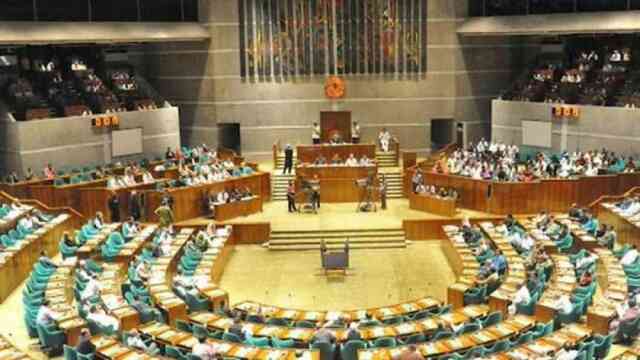
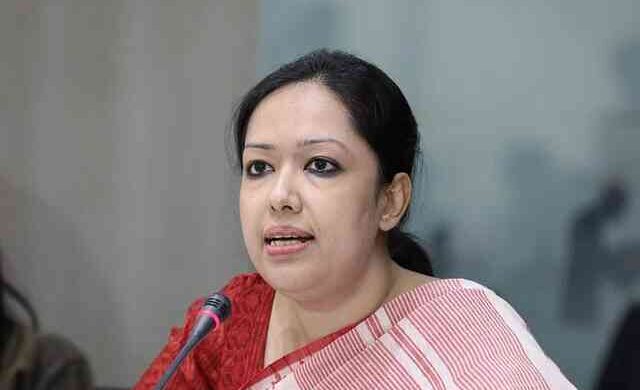
Finance Minister Amir Khosru Mahmud Chowdhury today (11 June) placed the national budget – with a financial outlay of Tk9.38 lakh crore – for the fiscal year 2026-27 in parliament, mapping out a strategy targeted at stabilisation and fiscal reform.
This is the first budget of the current BNP government after it took office through the 12 February general election.
Earlier, the Cabinet approved the proposed national budget for the fiscal year 2026-27 at a special meeting held at the Jatiya Sangsad Bhaban.
The meeting was chaired by Prime Minister Tarique Rahman in the Cabinet Room of the Jatiya Sangsad Bhaban, said Prime Minister’s Additional Press Secretary Atikur Rahman Rumon.
Finance Minister Amir Khosru Mahmud Chowdhury and other ministers and state ministers attended the meeting that began at about 10am and ended around 1pm.
According to high-level treasury sources, the government has set an ambitious overall revenue mobilisation target of Tk6.95 lakh crore to fund the massive public expenditure.
Out of the total revenue target, the National Board of Revenue (NBR) has been given the task of collecting Tk6.04 lakh crore. Additionally, Tk25,000 crore is expected to come from non-NBR tax sectors, while non-tax revenue (NTR) sources are projected to yield Tk66,000 crore.
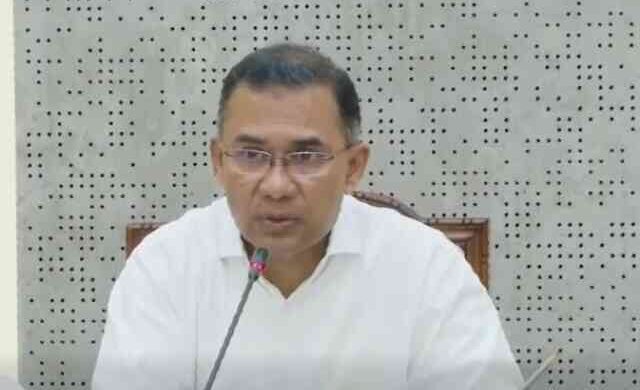
The borrowing plan was unveiled by Finance Minister Amir Khosru Mahmud Chowdhury while presenting the Tk9.38 lakh crore national budget in parliament today (11 June). Photo: Screengrab
The borrowing plan was unveiled by Finance Minister Amir Khosru Mahmud Chowdhury while presenting the Tk9.38 lakh crore national budget in parliament today (11 June). Photo: Screengrab
A major portion of the resource allocation will be consumed by debt servicing obligations.
The government has earmarked Tk1.27 lakh crore solely for interest payments on loans. Of the amount, Tk1.05 lakh crore will go towards servicing domestic debt, while foreign loan interest payments will require Tk 22,500 crore.
The draft proposal estimates the overall budget deficit at Tk2.43 lakh crore. To bridge this significant fiscal deficit, the government plans to borrow Tk1.09 lakh crore from foreign funding sources.
For domestic deficit financing, the administration will heavily rely on the country’s banking system, planning to borrow Tk1.12 lakh crore from commercial banks.
The remaining gap of Tk15,000 crore is projected to be met through the sales of national savings certificates.
This is the first budget of the BNP government this time following a landslide victory in parliamentary election held on February 12 this year. A BNP-led government had last presented its national budget for the fiscal year 2006-’07 under then Finance Minister M. Saifur Rahman.
The proposed budget, the largest in the country’s history, reflects the government’s commitment to economic recovery, investment promotion, human resource development and improved public service delivery.
According to budget documents, the total expenditure outlay has been estimated at Tk 9.38 lakh crore, while domestic revenue mobilisation is projected at around Tk 6.95 lakh crore. The overall budget deficit is expected to stand at Tk 2.43 lakh crore, equivalent to 3.6 percent of the Gross Domestic Product (GDP).
The government has set a GDP growth target of 6.5 percent and an inflation target of 7.5 percent for FY27, with the projected size of the economy estimated at Tk 68.30 lakh crore.
In his budget speech, the finance minister highlighted the government’s priorities in education, healthcare, employment generation, private-sector-led investment and social protection. He reiterated the government’s pledge to build a knowledge-based economy and expand opportunities for the country’s growing youth population.
The budget speech also featured a series of deregulation and business facilitation measures, including simplification of licensing procedures, modernisation of tax administration and expansion of digital services to improve the ease of doing business and attract both local and foreign investment.
Officials said the FY27 budget has been framed in line with the government’s electoral commitments and long-term development vision, placing greater emphasis on human capital development alongside macroeconomic stability.
The proposed budget will be discussed in parliament before its passage and implementation from July 1, 2026.