সোমবার, ১৬ নভেম্বর ২০২৬, ০২:০১ পূর্বাহ্ন


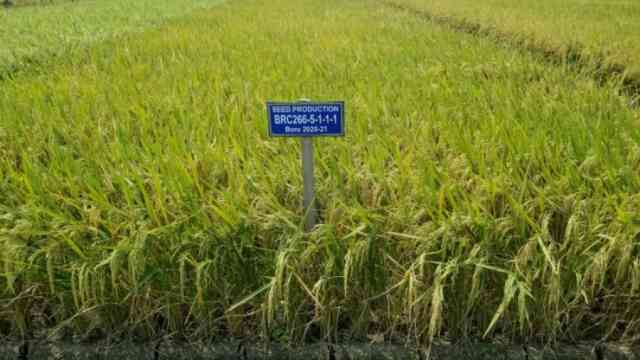
DHAKA, Nov 15, 2026 (BSS) – The government has intensified efforts to expand cultivation of BRRI dhan-118, an early-maturing, high-yielding rice variety, to address the risk of early floods in haor areas and minimise losses to Boro crops.
Officials concerned at the Ministry of Agriculture said seedbeds of the variety have been prepared in 1,600 demonstration plots across seven haor districts during the current Boro season.
Initially, 30 metric tonnes of seeds have been supplied for these demonstration seedbeds. This will enable haor farmers to cultivate the early-maturing rice variety during the current season.
Officials concerned said the variety, developed by the Bangladesh Rice Research Institute (BRRI) under the Ministry of Agriculture, is particularly important for agriculture in haor areas.
Every year, sudden early floods submerge Boro rice crops at the half-mature to mature stages, causing substantial losses to farmers.
In particular, flash floods originating from upstream hilly areas and excessive rainfall in April pose a risk of inundating vast expanses of rice fields before harvesting.
Against this backdrop, BRRI dhan-118 has created an alternative opportunity for haor farmers, as it can be sown and harvested seven to 10 days earlier than conventional varieties.
According to BRRI sources, one of the key characteristics of the variety is its cold tolerance during the reproductive stage. It can produce yields even amid severe winter conditions and temperature fluctuations in haor areas.
As a result, early sowing can help the rice mature and be harvested ahead of the usual schedule. This will provide farmers with an opportunity to bring their crops home before the period of heightened early-flood risk.
Trials have shown that when BRRI dhan-118 is sown early, between October 25 and November 1, it can produce around six tonnes per hectare even when the average temperature during the reproductive stage remains below 20 degrees Celsius.
On the other hand, experimental cultivation through normal sowing between November 15 and 20 produced a maximum yield of 6.9 tonnes per hectare in 145 days.
The variety has an average yield of 6.77 tonnes per hectare. Under favourable environmental conditions and with proper management, yields can reach up to 8.5 tonnes per hectare.
Its growth duration is generally 145 to 148 days. However, depending on the severity of winter, the duration may extend to 150 to 157 days.
Another notable characteristic of BRRI dhan-118 is its strong and sturdy plants, which are less likely to lodge during storms, rainfall or adverse weather conditions.
Its flag leaves also remain green during the ripening stage, reflecting a physiological characteristic of the variety.
In addition, it is comparatively less susceptible to diseases and insect attacks than conventional varieties.
In yield trials conducted by BRRI across 10 regions, the variety produced approximately 22.83 percent higher yields than BRRI dhan-28.
Considering its yield potential, early maturity and ability to withstand adverse environmental conditions, officials concerned expect the variety to play an important role in safeguarding Boro rice production in haor areas.
Agriculture experts believe that developing high-yielding rice varieties alone is not sufficient for rice cultivation in haor areas.
Ensuring appropriate sowing and harvesting times in consideration of local weather conditions and the timing of early floods is equally important.
In this regard, the early sowing and maturity characteristics of BRRI dhan-118 will create new opportunities for farmers in crop management.
The preparation of seedbeds of the variety in 1,600 demonstration plots across seven districts is primarily an initiative to expand the variety and demonstrate its practical suitability at the farmers’ level.
Through these demonstration plots, farmers will gain direct knowledge of its cultivation methods, yield potential and other characteristics.
At the same time, the initiative will create opportunities to expand its cultivation at the field level.
According to experts, Boro rice production in haor areas is closely linked to the country’s food security.
Therefore, expanding short-duration and cold-tolerant rice varieties is important to reduce crop losses caused by early floods.
They said BRRI dhan-118 could bring positive changes to agriculture in haor areas if it is sown at the right time, quality seeds are used and proper crop care is ensured in accordance with the advice of agricultural officials.
Officials concerned hope that the expansion of BRRI dhan-118 through demonstration plots during the current season will effectively help reduce the risk of early floods in haor areas, safeguard Boro rice production and minimise crop losses for farmers.
The variety may also contribute to maintaining the food-grain production capacity of haor areas, which are among the country’s important Boro-producing regions.
Asked about the variety, BRRI Director General Dr Md. Rafiqul Islam told Bangladesh Sangbad Sangstha (BSS) that BRRI dhan-118 is a promising variety for farmers in haor areas.
“Every year, farmers in haor areas face the risk of substantial losses to their Boro rice crops due to early floods,” he added.
“Taking this risk into consideration, we developed the variety so that rice can be harvested seven to 10 days earlier than conventional varieties,” he said.
“Its cold tolerance during the reproductive stage, high yield potential and short growth duration will help safeguard rice production under the adverse conditions of haor areas,” he said.
“During the current season, an initiative has been taken to expand the variety among farmers through 1,600 demonstration plots in seven districts,” he said.
“We hope farmers will be able to reduce the risk of early floods and safely bring their crops home by cultivating this variety,” he said.
“As a result, BRRI dhan-118 will make an important contribution to increasing rice production in haor areas and ensuring the country’s food security,” he added.
Regarding the newly developed rice variety, Agriculture Ministry Secretary Md. Selim Khan told BSS that the hardships and sufferings of haor farmers have long been a matter of concern.
“After working hard throughout the year, farmers often see their hopes and labour washed away by early floodwaters just when they are waiting to bring their rice harvest home. We understand their suffering,” he said.
“Prime Minister Tarique Rahman has given special directives to take necessary measures to alleviate the longstanding sufferings of haor farmers and protect their crops from the risk of early floods,” he said.
“In line with the Prime Minister’s directives, we have taken effective initiatives to protect farmers’ crops,” he added.
He said BRRI dhan-118 was an important part of those initiatives.
“The special feature of this variety is that it can be harvested seven to 10 days earlier than conventional varieties,” he said.
“As a result, farmers will have the opportunity to bring their rice harvest home before the period of heightened early-flood risk,” he said.
“During the current season, seedbeds of this variety have been prepared in 1,600 demonstration plots across seven haor districts,” he said.
The secretary said the government’s efforts to ensure that haor farmers could safely bring home the harvest of their year-long hard work would continue.
“Our goal is to bring smiles to farmers’ faces, ensure the protection of their produce and make agriculture profitable and sustainable,” he added.
“We will continue working alongside farmers to implement the Prime Minister’s directives,” he said.