শুক্রবার, ১৭ জুলাই ২০২৬, ০৬:৩৩ অপরাহ্ন



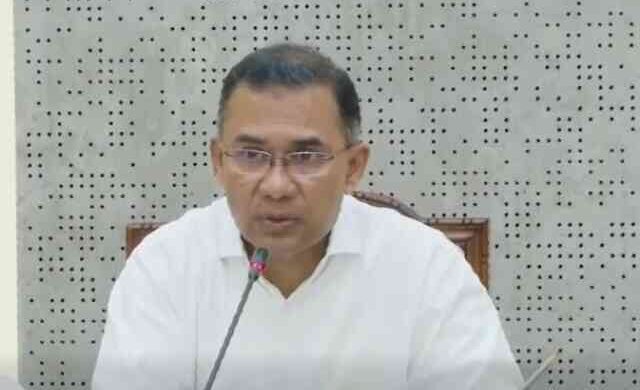
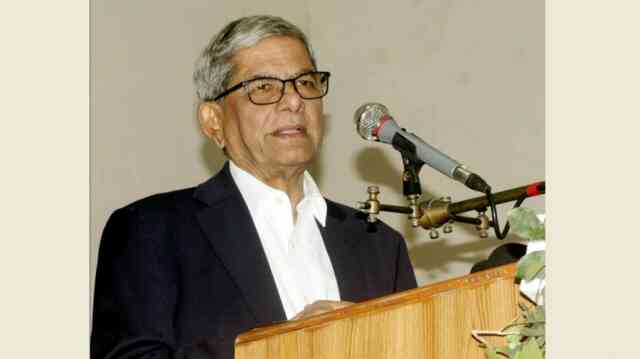
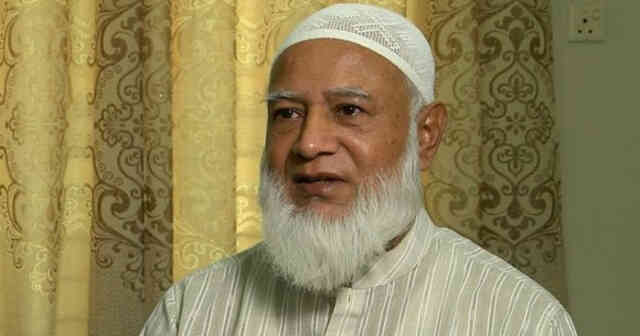
DHAKA, Nov 12, 2025 (BSS) – Bangladesh Nationalist Party (BNP) Acting Chairman Tarique Rahman today virtually addressed a discussion as chief guest on “National Revolution and Solidarity Day”, organized by the party at Bangladesh-China Friendship Conference Center in the capital’s Agargaon.
Full text of his speech is given below:
As I see it, November 7, 1975, was the day to identify the enemies and allies of Bangladesh.
Whenever we discuss Bangladesh’s Liberation War and every historical context of the country, one quote comes to my mind: “If you are always fixated on the past, one eye becomes blind; if you forget the past, both eyes are blind.”
Therefore, while we don’t need to dwell on practicing history all the time, ignoring lessons from history in shaping the future is also a historic mistake. Based on your important discussions about the historic November 7, 1975, I would like to share my thoughts.
Those who wanted to turn Bangladesh into a submissive state, those who sought to deny the people’s democratic and political rights to establish a one-party authoritarian rule, and those who tried to undermine the honor and glory of the nation’s army — a symbol of courage and dignity — were defeated on this day, November 7, 1975, through the historic revolution of patriotic soldiers and citizens.
After a long path of conspiracy, the defeated evil forces of November 7, 1975, later regrouped under the name of the Grand Alliance and again attempted to turn the country into a submissive state. They tried to weaken the army by carrying out a planned massacre at the BDR Pilkhana and deprived the people of their voting rights and democratic political rights to establish fascist rule in the country.
Through the sacrifices of thousand of martyrs, and the heroic uprising of the people, the country was freed from fascism after more than one and a half decades. BNP believes that the 1971 war was to achieve independence, and 2024 was for protecting the independence of the country and the people.
Therefore, our main commitment of this November 7 should be that no one in the future can violate the rights of the country or its people or turn the country into a submissive state. Achieving this commitment requires national unity. We must wholeheartedly embrace the spirit of the November 7 revolution of the soldiers and the people to maintain national unity in Bangladesh’s socio-economic, geographical, and political realities.
From the 1971 Liberation War, the November 7, 1975, revolution of the soldiers and the people against submissive evil forces, the 1990 anti-autocracy movement, to the 2024 anti-fascist mass uprising, every revolution and uprising in history had one central desire. What is that? This was to establish the rights of the people in an independent Bangladesh.
Even in freeing the country from the clutches of a one-and-a-half-decade-long fascist cycle, countless people lost their lives. Just in July–August, more than 1,500 people were martyred. Why did students, citizens, women, men, farmers, and workers take to the streets in the movement to overthrow fascism?
We need to understand that the people took to the streets to establish their rights in the state and politics. As a political worker, I believe that countless people did not sacrifice their lives to establish the rights of a particular political party or to create bargaining opportunities for them.
When the groundwork for establishing a government accountable to the people through direct elections is being prepared, a few political parties, taking advantage of the interim government’s weaknesses, stood against the establishment of democratic political rights for the people.
I want to draw the attention of my associates of the anti-fascist movement again: instead of threatening the current weak interim government, face the people directly in February. Every political party must remember that, beyond their own supporters and leaders, there exist a huge number of non-political or neutral citizens.
As representatives of political parties, I consider it our important duty to focus on fulfilling the expectations of these millions of non-political or neutral people.
For months, the people have seen representatives of many invited political parties discuss various matters and let a significant period of the interim government’s term pass. But in these discussions, were the day-to-day interests of that large non-political or neutral population addressed?
Did the invited political representatives discuss agriculture, education, health, and employment with the interim government? Were issues concerning women’s safety and youth employment given priority in discussions? Were the daily struggles of farmers, laborers, low-income workers, and the lower-middle-class population included in the political agenda?
In this country, there have been fierce movements not only for quota reform but also for road safety. From September 2024 to September 2025, in the past year alone, at least 7,000 people have died on the roads, 48% of whom were women, children, and pedestrians. Additionally, 13,000 people have been injured.
Bangladesh now ranks among the countries with the highest number of road accident casualties. Yet, despite hundreds of rounds of discussions with the interim government, did road safety get its proper place in these discussions? These questions are not meant to assign blame.
Rather, as a political worker, I ask myself: our politics, then, is for whom? In the country’s recent situation, I would like to share some of my observations and questions. I hope you will bear with me as I take a bit of extra time.
I believe that for meaningful reform of mainstream politics, the issues of public safety and citizens’ daily lives should receive more attention in political plans than purely theoretical reforms. More focus is needed on maintaining law and order.
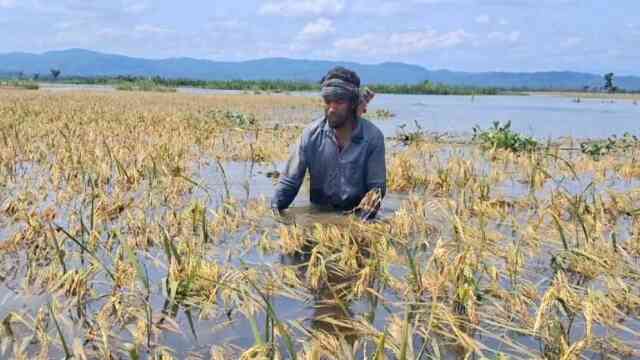
In today’s discussion, I also want to highlight a few more issues. From what I have learned, the country produced 1.15 crore tons of potatoes this year. Farmers seem to be in trouble because the cost of producing potatoes and storing them in cold storage is about 25–27 BDT per kilogram, yet they cannot sell their potatoes at even half the cost.
Potato farmers are facing an estimated loss of nearly Taka 3000 crore. On the other hand, if the state had to spend almost the same amount of money to hold a said unnecessary referendum to satisfy a few political parties, then I believe it is far more important for the potato farmers to get a fair price for their crop than for the country to conduct a referendum. I raised the issue for the countrymen’s thinking.
Now, regarding onion production, from what I have known, farmers have the capacity to produce more onions than domestic demand, and they are producing a sufficient quantity. However, due to a lack of proper onion storage systems, the country still depends on imports every year.
I believe that investing thousands of crores of public money in establishing proper storage for onions would be far more acceptable to farmers than spending the same amount on a said “referendum.” But where do the affected farmers have a voice?
Currently, more than two crore women are working in sectors from the garment industry to other industries. If these women are forced to work five hours instead of eight hours, who will compensate them for the remaining working hours? A fear has been created among working women in the country that whether the talks of reducing women’s working hours is subtly encouraging employers not to hire women at all?
When people are becoming unemployed, alleviating this fear of job loss among working women is far more urgent than a said “referendum” at this moment.